Showing posts with label Comics. Show all posts

Friday, November 10, 2006

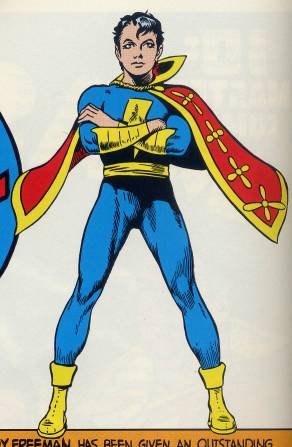
Captain Marvel Junior


As superhero comics grew in popularity, and more comics started crowding the shelves, publishers needed to find new ways to attract readers, most of whom were kids. One bright man at National (later, DC) comics decided that although Batman was popular, kids couldn’t identify with him- they needed someone their own age in the book. Thus, Robin was born.

And, as they had done after Superman’s debut, rival publishers rushed to copy the formula. Captain America had Bucky, the Human Torch had Toro, Green Arrow had Speedy (which always confused me because I thought someone named “Speedy” would team up with the Flash), and, in a novel twist, the young hero Star Spangled Kid had a grown-up sidekick named Stripesy.

With the exception of Robin, these sidekicks never really achieved the same level of popularity and name recognition of their grown-up counterparts. And with the exception of none of them, they were all inferior versions of their guardians.

Well- there was one exception- Captain Marvel, Jr. And with the first volume of The Shazam Family Archives, DC has finally released a deluxe volume of his adventures. (Technically, the Shazam Family also included Mary Marvel, but her first appearance is the last story in the book, so I guess she’ll have a bigger presence in subsequent volumes). Anyway- back to Cap, Jr.

Freddy Freeman was out fishing with his grandfather one day when the rescued a man who appeared to be drowning. Little did they know this man was the evil Captain Nazi (hey- it was WWII, who else would he encounter?) who was just lost a fight with Captain Marvel. Captain Nazi quickly recovered, drowned the old man, crippled Freddy with a blow from an oar and made off with the boat. Luckily, Captain Marvel was nearby and, hoping to save the boy’s life, he took Freddy to the wizard Shazam. Shazam saved Freddy, and also bestowed upon him superpowers. All Freddy would have to do was say “Captain Marvel” and he would be transformed into Captain Marvel, Jr. (Which also meant that he could never say his own name without turning back into Freddy.)

Junior took up residence in Master Comics #23 (Feb. 1942), and got his own title the following November. At the beginning, he was drawn by Mac Raboy, one of the true greats of the era. He had a great style, with lots of fine linework. His use of photo-references enhanced the realism and grittiness of his art, which was a definite contrast with the much lighter style CC Beck employed on Captain Marvel’s titles.

And the tenor of the stories reflected the difference styles. Teenaged Billy Batson (Cap’s alter ego) worked for WHIZ radio and had a pretty nice house of his own. Crippled Freddy Freeman (Shazam gave him superpowers, but couldn’t fix his leg) was a paperboy who lived in a depressing attic in a rundown neighborhood. Cap’s arch-enemies were Dr. Sivana who tended to be more naughty than evil, and Mr. Mind, an intelligent worm. Junior had to deal with Captain Nazi (who definitely would kill the kid if he had the chance), Mr. Macabre (who apparently was Fawcett’s Joker wannabe), and lots of kidnappers. Freddy always seemed to be in a lot more real danger than Billy was.

What’s great about Junior is that he could hold his own against really scary villains. As I said earlier, you had the feeling that if Captain Nazi ever managed to get the drop on him, Junior was toast. But Junior always made it to the end of the story. I don’t think Batman would have ever let Robin even contemplate going up against the Joker by himself. And Junior’s powers were probably pretty close to Cap’s own levels. He might have been a kid, but he was a serious contender.

The only problem with this volume is that, at this early stage, Junior had a limited rogue’s gallery- there are 15 stories in the book. In these 15 stories, he fights Captain Nazi 5 times, and Mr. Macabre 3 times. Although he does go up against the Japanese air force in one story, he spends most of the rest of the stories fighting street hoods. For example, in “Case of the Cripple Crimes,” Freddy is taken in by Dr. Krool and Prof. Swype, two Fagin-types who teach orphans how to pick pockets. The artwork is very nice, the story dark, but these two criminals are definitely outclassed by Junior.
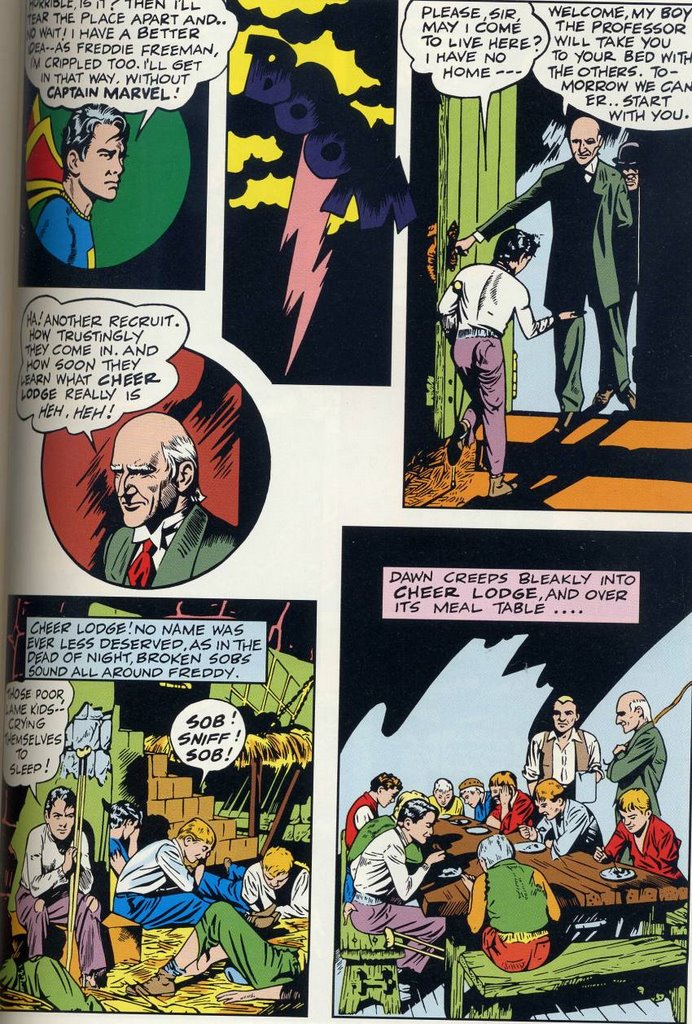

I like the fact that Freddy’s youth, poverty and physical limitations are used to good effect to get him involved in cases. More than once he is put into situations where he is in real danger. But once he turns into Captain Marvel Junior, he is way too powerful for most of his foes, and the dramatic tension goes away.

Still, to get back to my original point, Cap Junior made a great junior-league hero. While I have a hard time putting up with the Golden Age Robin even when Batman’s with him (and Robin was still more appealing than Bucky Barnes), I am enthralled by Junior’s adventures.

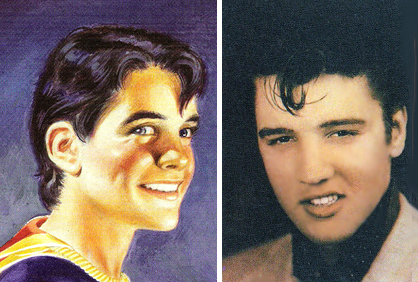
And I’m not the only one who felt that way. Apparently, a young boy from Tupelo, Mississippi was a huge fan, going so far as to style his hair in the same manner. And when he got a little older, and a little richer, he had clothes modeled on Junior’s- right down to the cape and a lightning bolt on his belt buckle.

That boy?*
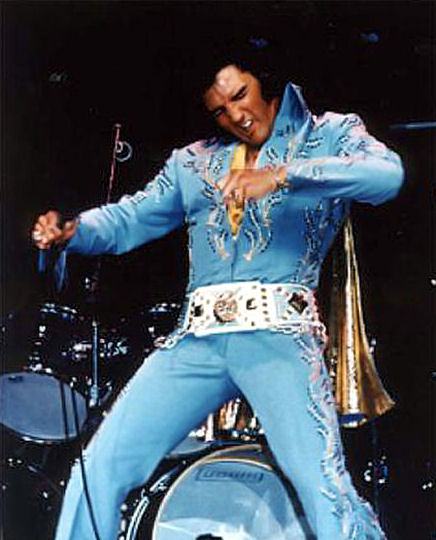
*Think I'm kidding? Check this out-
Saturday, October 21, 2006

The Dark Knight Departs

DC Comics is doing the world a great favor printing their Batman Chronicles books. These are inexpensive trade paperbacks that reprint the Batman's adventures in chronological order, starting with his first appearance in Detective Comics #27. Volume 1 covers Detective 27 - 38, and Batman #1.

Among the milestones in this volume are the first appearances of the Joker, the Cat (who later became Catwoman), and Robin. It's the latter's appearance that inspires this little column.

The mythology of Batman comics is that our hero was originally some hardcore loner, who moved in the shadows and dispensed his own unique brand of vigilante justice. However, some time in the 50s, he turned into this cheery guy who was seen in the daytime and palled around with Superman. It wasn't until the late 60s that he returned to his roots.

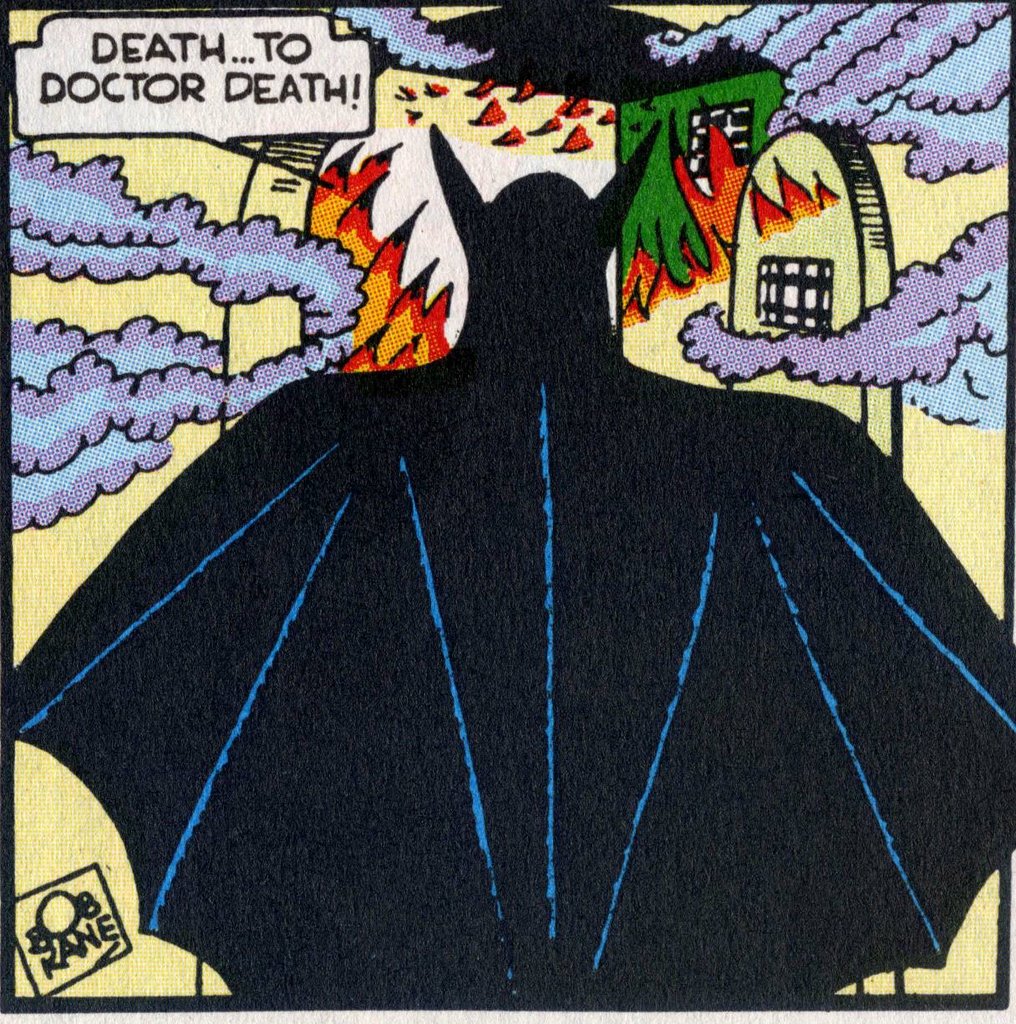
For an example of the vigilante, check out the last panel of "The Batman Meets Dr. Death" (Detective 29):


Yup- his third appearance, and he takes the villain's suicide in stride.

In part two of "Batman Vs. The Vampire" (Detective 32), he's a bit more pro-active in seeing his enemies off:


So, yeah, this is really the Dark Knight of mythology.

But how long did this dark period last? Not having access to the complete Batman library, it seemed that he was like this for quite a while and had built up quite a library of these moody stories. The myth was that the comics code of the early 50s ruined Batman, and that Neal Adams brought him back when started drawing the comics in the late 60s.

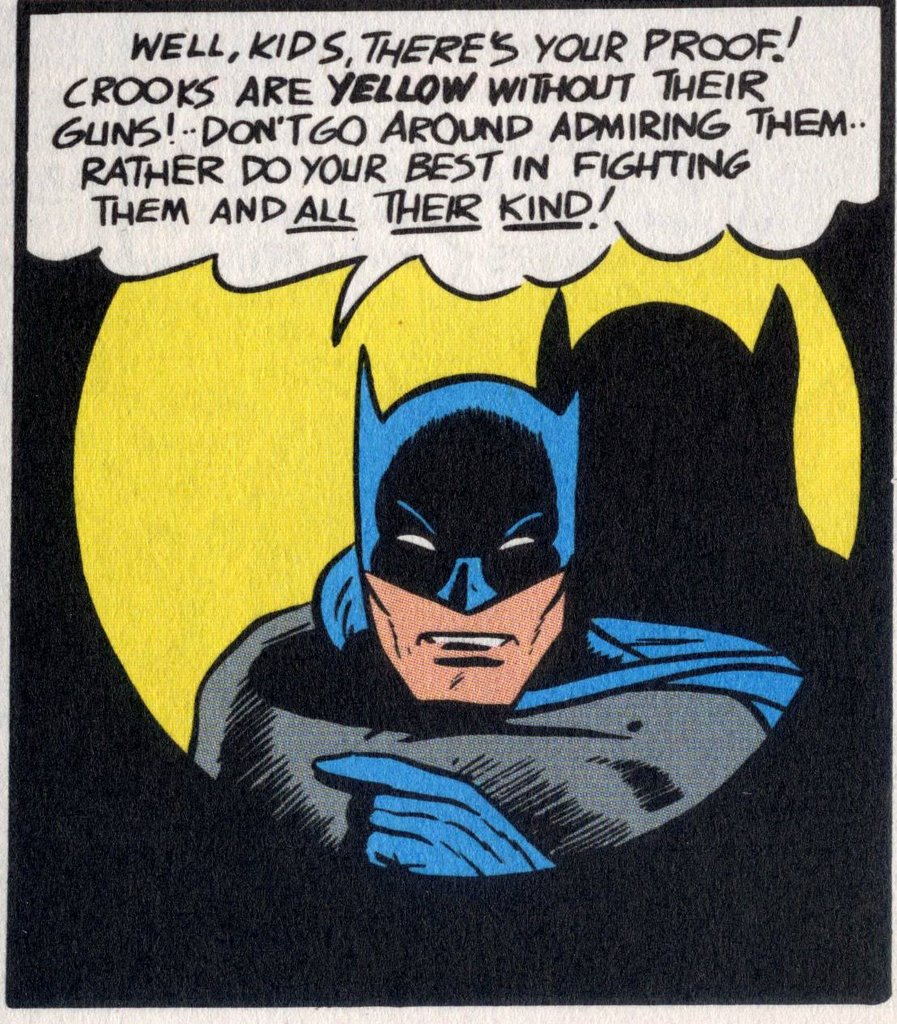
Having the Batman Chronicles was like a splash of cold water on my face- because Batman doesn't even make it to the end of the first volume before he becomes wussified. In Detective 38, Batman witnesses the murder of young Dick Grayson's parents, and becomes the boy's ward. Dick becomes better known as Robin, and Batman loses his dark aura. Here's the panel that signals the new, lighter, Batman:


Look at it- he's smiling, and calling Dick a "reckless young squirt." Not only that, but he's a bit of a nag, too:


So much for "Death to Dr. Death" Batman. Say hello to "Reckless Young Squirt" Batman. And how long did it take to make the transition? Less than a year- Batman debuted May, 1939 and Robin popped up April, 1940. A 12-month golden age.

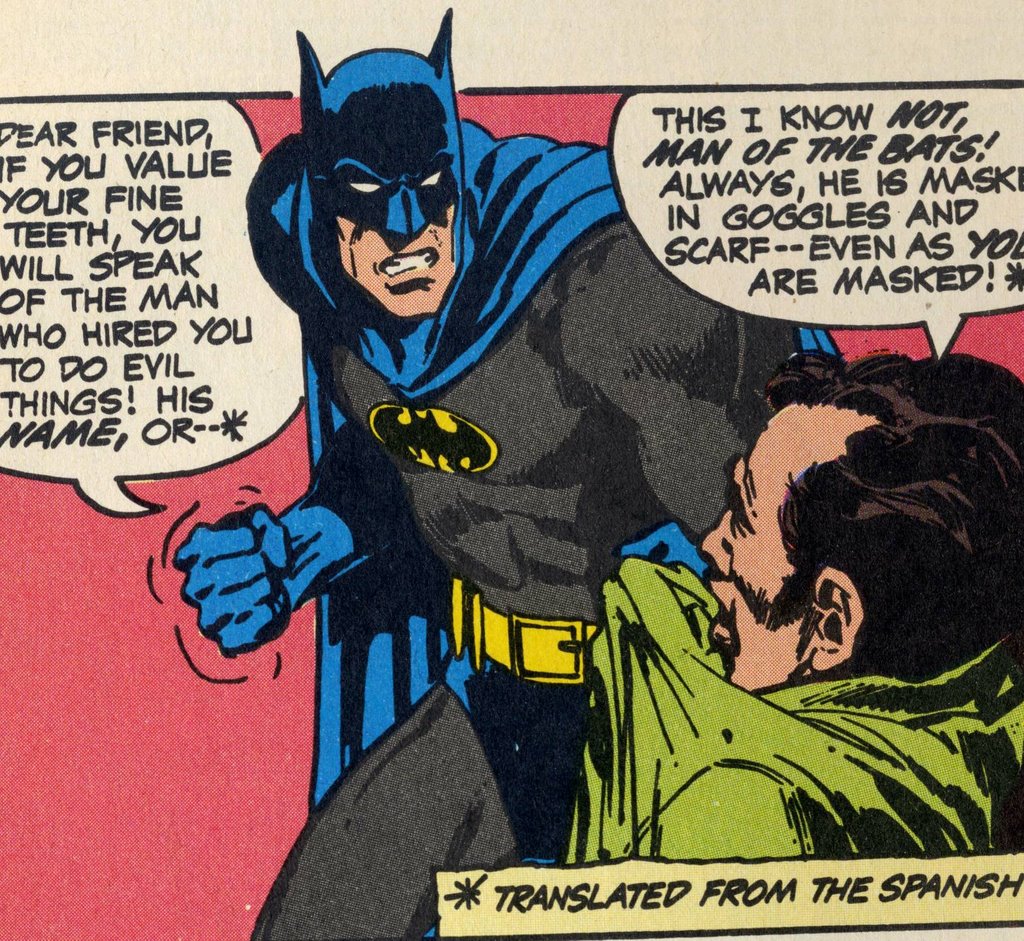
It wasn't until 1968 that we saw this Batman again:


So- one year dark, 28 years light. Quite a ratio, eh?

Sunday, October 08, 2006

Boys Will Be Boys

Wildstorm has released the newest title from writer Garth Ennis- The Boys, and I can't recommend it highly enough.

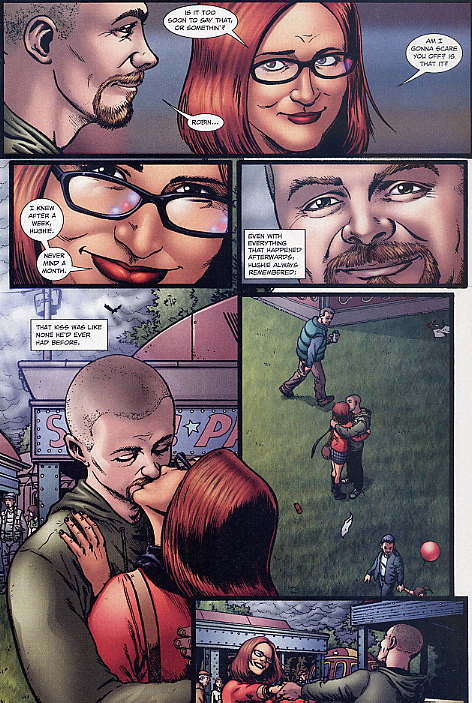
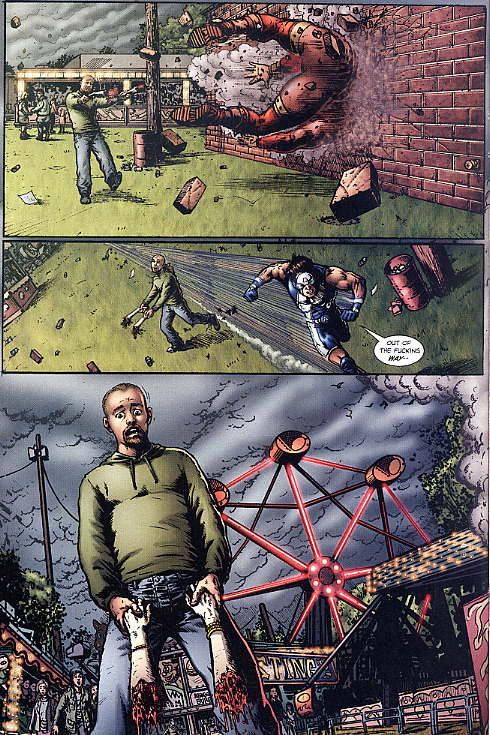
The basic premise is simple enough- The Boys are a team of normal humans who are tired of being pushed around by super-powered beings. Check out this opening sequence from the first issue in which we see "Wee" Hughie and his girlfriend come between a superhero and his prey. (Sorry if it's too small to read the text, but I haven't figured out how to do that "click on the picture to see a bigger version" thing. I think the pictures tell the story pretty well, though.)


Thanks to this little encounter, Hughie is recruited by Billy Butcher to join "The Boys", a CIA-sponsored group whose mission is to keep an eye on super-powered beings, and use whatever means necessary to "dissuade" them from using their powers.

The whole Hughie sequence came out of the blue- it was completely unexpected (in the book, the two pages weren't facing each other- you had to turn the page to see the bloody outcome, making it that much more startling and- dare I say it?- hilarious.) The book's first two issues are very darkly humorous, and have me waiting anxiously for the next one.

I really like the idea of a book from outside the POV of a superhero, where we can see how their actions affect the "little guy." I've always been able to suspend my disbelief for a lot of what goes on in comics- flying, time travel, super-strength, etc. One thing that has always bothered me, though, is the rampant destruction that goes on in most titles. In the Marvel Comics world, Manhattan seems to be under constant attack- the real estate surrounding Avengers Mansion alone must be pretty much uninsurable. Yet, we are supposed to believe that the average citizen takes it all in stride- that the major destruction that even a run of the mill battle between superbeings can lead to doesn't phase them. They rebuild the block, and move on.

Marvel addressed this issue in regard to The Hulk- that his city destroying rampages never killed or seriously harmed any civilians because they were always able to evacuate the city in plenty of time to get them out of harm's way. I call BS on that- it's just a convenient way to direct attention from the fact that in the real world having a superhero in your city would be more a curse than a blessing.

It would be nice if The Boys addresses this issue, but I have the feeling it won't get too deep into it- Ennis seems to be going for more a dark humor vibe than a think piece. Still, so far, two issues down, and I'm waiting for more.

Thursday, September 14, 2006

Oh Captain, my Captain


If you held a gun to my head and asked my to tell you my 5 favorite comic characters, I’d probably list the following in some order: Captain Marvel (the original), Plastic Man, The Spirit, Batman and the Joker. (Actually, first I’d probably make some remark about how putting the gun to my head was not, technically, making me give you the names- that I was doing it of my own free will.*)

Looking at the list, something interesting sticks out about the first three characters- they’re all classic Golden Agers that really don’t translate too well to modern day comics. All three are, for lack of a better word, innocent. They’re funny, they can be goofy, they tend to have odd rogues galleries- all characteristics that put them at odds with present-day comics.

Of those three, Captain Marvel is by far my favorite, and he is the one that has the biggest injustice being done to him. He started out around 1939/1940 in the wake of the success of Superman. His alter ego is a young boy- Billy Batson- who one day was taken to meet a mysterious wizard named Shazam. When Billy says the wizard’s name, he is transformed into Captain Marvel, a superstrong, invulnerable, flying hero.


Cap’s adventures were much lighter than Superman’s and (especially) Batman’s. Cap always smiled. Where Superman’s evil genius nemesis Lex Luthor was devising deadly schemes to kill him, Cap’s evil genius nemesis, Dr. Sivana, had schemes that resembled those of The Brain (from “Pinky and the Brain.”) Where Batman’s foes were the Joker and Two-Face, Cap had to battle Mr. Mind, a super-intelligent worm (!) (although, to me, he looked more like a caterpillar).

As time went on, the Marvel Family grew to include Billy’s sister, Mary Marvel, Freddy Freeman (who became Captain Marvel, Jr.), Uncle Dudley (who had no superpowers, but pretended he did, and everyone played along), the Lieutenant Marvels (Fat Billy, Tall Billy and Hill Billy), Talky Tawny (a tiger who was given a serum to allow him to talk and walk upright, and was often seen around Fawcett City in his dapper suit and hat), all the way down to Hoppy the Marvel Bunny.

You can easily see these people were not living in the same universe as the Punisher and Wolverine.

At their peak, Captain Marvel comics were the highest-selling comics in the country, with sales surpassing those of "The Big Three"- Superman, Batman and Wonder Woman. DC comics (Superman’s publisher), started a lawsuit, claiming Cap was ripping off Superman. The suit dragged on into the 50s, with Fawcett (Cap’s publishers) eventually agreeing to stop publishing the adventures of the Marvel Family.

Ironically, some time later, when Fawcett went out of business, DC bought the rights to all of their characters and decided it was time to re-introduce Captain Marvel to the masses. In 1972, DC put out the comic “Shazam!”, featuring art by Cap’s original artist, CC Beck, and stories that attempted to recapture the spirit of the old books. By now, however, comic readers were older and used to more “realistic” characters like The Fantastic Four, or Spider-Man- characters with flaws and foibles. Despite also having a popular live-action Saturday morning TV show, Captain Marvel never really approached his old levels of popularity, and the comic was eventually cancelled.

Cap became a back-up character for a while- doing guest appearances in other books. In the late 80s, another attempt was made to bring back “The Big Red Cheese,” but this also never really caught on, and was cancelled after a couple years.

So where am I going with this?

Well, three words- Captain Marvel’s back! Or is he?

DC Comics recently had huge cross-over event called “Infinite Crisis”, which affected all of the characters DC publishes, and launched a mini-series called “The Trials of Shazam!”. One of the results is that magic doesn’t work like it used to, and the old wizard, Shazam, who gave Billy Batson his powers, is dead. Which means that Captain Marvel is the new Shazam. And he’s been driven crazy by the responsibility. In the beginning of issue #1, he seriously wounds a couple of bad guys, just because he can.

Why? Why in the comics world is it assumed that in order for a character to be “good” or “relevant”, he has to become The Dark Knight? It worked for Batman (to a point) because that was always part of his character, but this is should be a light-hearted book.

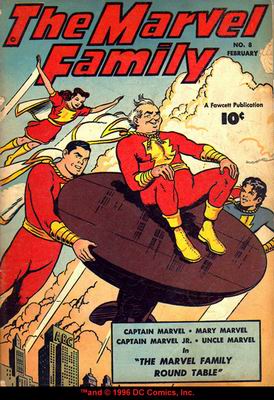
This is Captain Marvel:


This is not:


Would “All in the Family 2006” feature an Archie Bunker who’s a member of the KKK? Would a modern “My Favorite Martian” have Uncle Martin secretly trying to pave the way for a takeover of Earth? I shudder to think at what “Hogan’s Heroes” would be like if it were written as a modern comic.

If you have to change a character so much that he’s the antithesis of what he used to be, just give up. Let him fade away and write a new character. The fans will appreciate it more, I’m sure.

*Inside Joke

Thursday, August 17, 2006

Flash in the (bed)Pan


Haven't blogged for a while- been a little busy. I'm still too busy to organize my thoughts, but I wanted to leave this little tidbit.

As I've said before, I'm a geek, and one of my geekly loves has been comics, especially horror comics and superheroes, with DC heroes being, by far, my favorites.

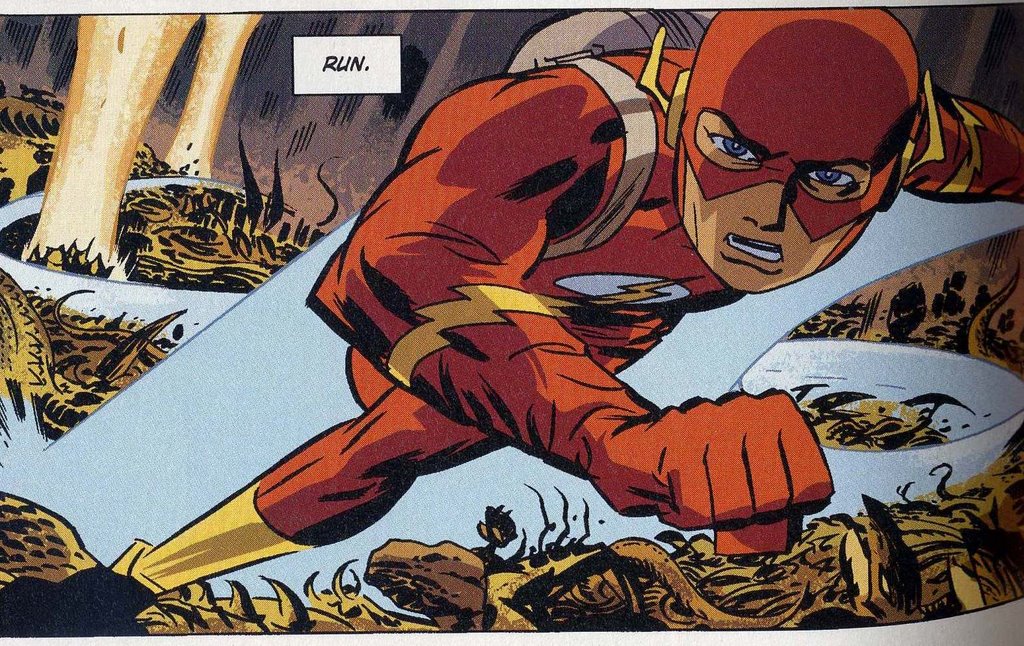
Anyway, I recently read an excerpt of a book entitled The Physics of Superheroes, in which it examined how certain heroes could or could not exist in our world. One of the heroes, mentioned was the Flash- basically, it examined how many calories he would have to eat to run 60 mph across the country (which is pretty piddly for the Flash). Anyway, the author (a physics professor) calculated how many calories he would burn up, and therefore, how much food he would have to consume to do it. I forget the exact number, it was a heckuva lot. Millions of calories, I think. Said professor concluded that this is one reason the Flash could not exist in our world.

So, I got to thinking- maybe the Flash has a really efficient metabolism. Maybe his stomach is like a nuclear reactor, and can break apart the very molecules of food he eats so that he can harness all the energy of the atom directly. That would surely fuel his cross-country journey?

But, if he was so efficient, does that mean he would never have any waste to eliminate? Does the Flash ever use the bathroom? Also, would that mean that the "Fastest Man Alive" would never get a case of the runs?